

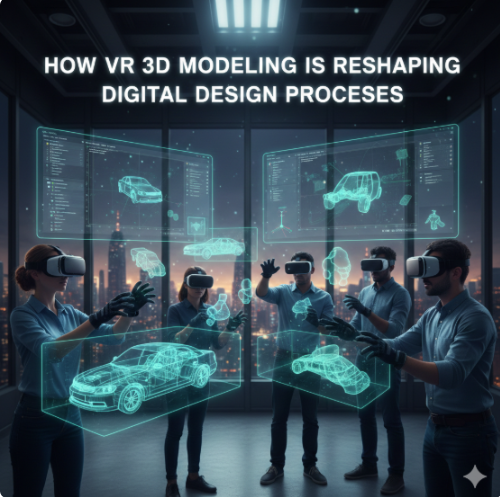
Digital design has always kept up with technology, like drafting tables to CAD software, and static renderings are not interactive. VR 3D modeling defines the new wave of designers working, thinking, and creating today.
Virtual reality is changing digital design, which used to be a screen activity, into a complete experience by putting the designers within their designs. It is not only a revolution of a higher order of visuals, but a revolution of the way ideas are generated, tested, and refined.
From Observation to Immersion
Conventional digital design is based on viewing the models remotely. Designers spin items on screens, zoom in and out, and visualize the experience of spaces or products in real life. The VR 3D modeling removes this distance by enabling designers to enter their playground.
Rather than perceiving depth and scale, design artists perceive them intuitively. The result of this immersion is more intuitive decision-making and assumptions made at the premature stages of design. In the case of a contemporary 3D visualization firm, the latter translates to providing the experiences that are as close to reality as ever.
Faster Concept Development and Iteration
The pace is paramount in the modern design environment. VR worlds can enable designers to draw, carve, and manipulate ideas instantly with natural motions.
The VR 3D modeling allows exploration of ideas quickly without having to struggle with complicated menus or redrawing them again. Designers are able to experiment with different layouts, forms, and materials at the same time. This hastens the ideation process and maintains the creative flow, which traditional processes frequently find hard to sustain.
Improved Spatial Accuracy and Design Quality
VR 3D modeling has one of the strongest influences on spatial comprehension. Mistakes are easily seen when the designers can walk around a space or touch a product full-size.
The problems with proportion, circulation, ergonomics, and visual balance are simpler to discover at an early stage. This results in high-quality design and reduced revisions of the design at a later stage. A 3D visualization firm using VR can enable the client to make sure that they do not incur expensive design changes since they can test the ideas before production or construction.
Redefining Collaboration in Digital Design
Design is not often an individual undertaking. The 3D modeling is changing the collaborative model by establishing a virtual space where teams can work and examine projects in a shared environment, and also revise them.
Stakeholders are able to experience designs in real-time and give feedback in real-time as opposed to looking at screenshots or tapes of recorded walkthroughs. Designers, clients, and engineers are able to communicate on changes as they are standing in the same virtual model, even though they are miles away physically.
In the case of a 3D visualization company, the teamwork method enhances communication, alignment, and trust among projects.
Bridging the Gap Between Design and Stakeholders
Communication is one of the issues in digital design that has existed for a long time. Technical drawings or a 3D software interface are not comprehensible to all people.
This is made simple through VR 3D modeling because design experiences can be understood anywhere. Clients do not have to envision results anymore; they can see and touch them. This understanding eliminates misunderstanding and assists the involved parties in making certain decisions at an earlier stage.
Consequently, VR is increasingly employed by the 3D visualization companies to improve the level of interaction with clients and simplify approvals.
Seamless Integration with Existing Workflows
Although VR opens up new possibilities, it is not the one that replaces traditional tools completely. Instead, it complements them.
A typical process would be designers starting with standard modeling programs, transitioning to VR to experiment and test, and back to desktop applications to hone the design. This hybrid model permits VR 3D modeling to optimize the existing digital design pipelines without interrupting them.
Innovative 3D visualization firms realize that VR is optimally a layered application, but not a single solution.
Preparing Digital Design for the Future
VR will become a part and parcel of digital-design procedures as hardware is more approachable and software is more advanced. It will also be provided with AI integration, real-time rendering, and cloud collaboration.
With the use of VR 3D modeling today, a designer and visualization department is not only enhancing the existing work processes–they are training to meet the next generation of digital creation.
Conclusion
VR 3D modeling is transforming the digital design into an experience as it is redesigning the digital design processes. It enhances speed in ideation, enhances accuracy, collaboration, and removes communication rifts between designers and stakeholders.
To any 3D visualization firm that wants to remain relevant and innovative, VR is not a vision of the future anymore, but one of the benefits that it has in the present. With the constant changes of digital design, immersion will cease to be a choice and will become the standard.